IBM Leadership Academy
IBM Leadership Academy is the primary resource for career development programs and resources serving a global community of over 300,000 IBM employees.

OverviewIBM makes career growth and continuous learning a priority for its employees, so finding programs and resources for leadership development should be easy.
The original Leadership Academy website—launched in 2015—had an outdated design and maze-like navigation that made it difficult for users to find what they needed.
By overhauling the user experience, I significantly improved usability and increased content engagement and program enrollment rates—despite workplace challenges surfaced by the Covid-19 pandemic—and Net Promoter Score (NPS) by 25 points.
The scope
Improve overall usability of the IBM Leadership Academy website by uncovering the needs of IBM employees across three career personas: Manager, Executive, and Technical Leader.
My roleAs design lead, I conducted user research and usability testing, created prototypes, and determined the overall UX direction of the new Leadership Academy website.
I also educated my teammates and our executive stakeholders on the various UX and Enterprise Design Thinking processes necessary to create a product that would not only better serve our users, but also improve business results such as program enrollment rates and Net Promoter Score (NPS).
ProcessDiscovery research
Before I joined the team, user research had never been done before. I advocated for this critical part of the design process to my executive stakeholders by connecting user needs to business impacts like NPS score and program enrollment rates.
I conducted user testing for the original Leadership Academy website with a group of 17 global sponsor users, each representing one (or a combination) of the three personas: Manager, Executive, or Technical Leader. My goals were to understand the challenges each persona faced when navigating the website and observe how one would complete a task to find information relative to each persona. I asked each user to walk us through two tasks: one that all visitors may complete regardless of career and one specific to their persona.
As a result, I uncovered pain points unique to each persona as well as universal pain points:
“I find it to be very busy, my eyes have no idea where to go.”
“It’s hard for me to tell what's most important or what the Leadership Development team wants me to focus on.”
“It's not super obvious what the different areas are for, just by glancing at them, unless you knew what you were coming here for.”
“Could be more straightforward, explicit and engaging.”
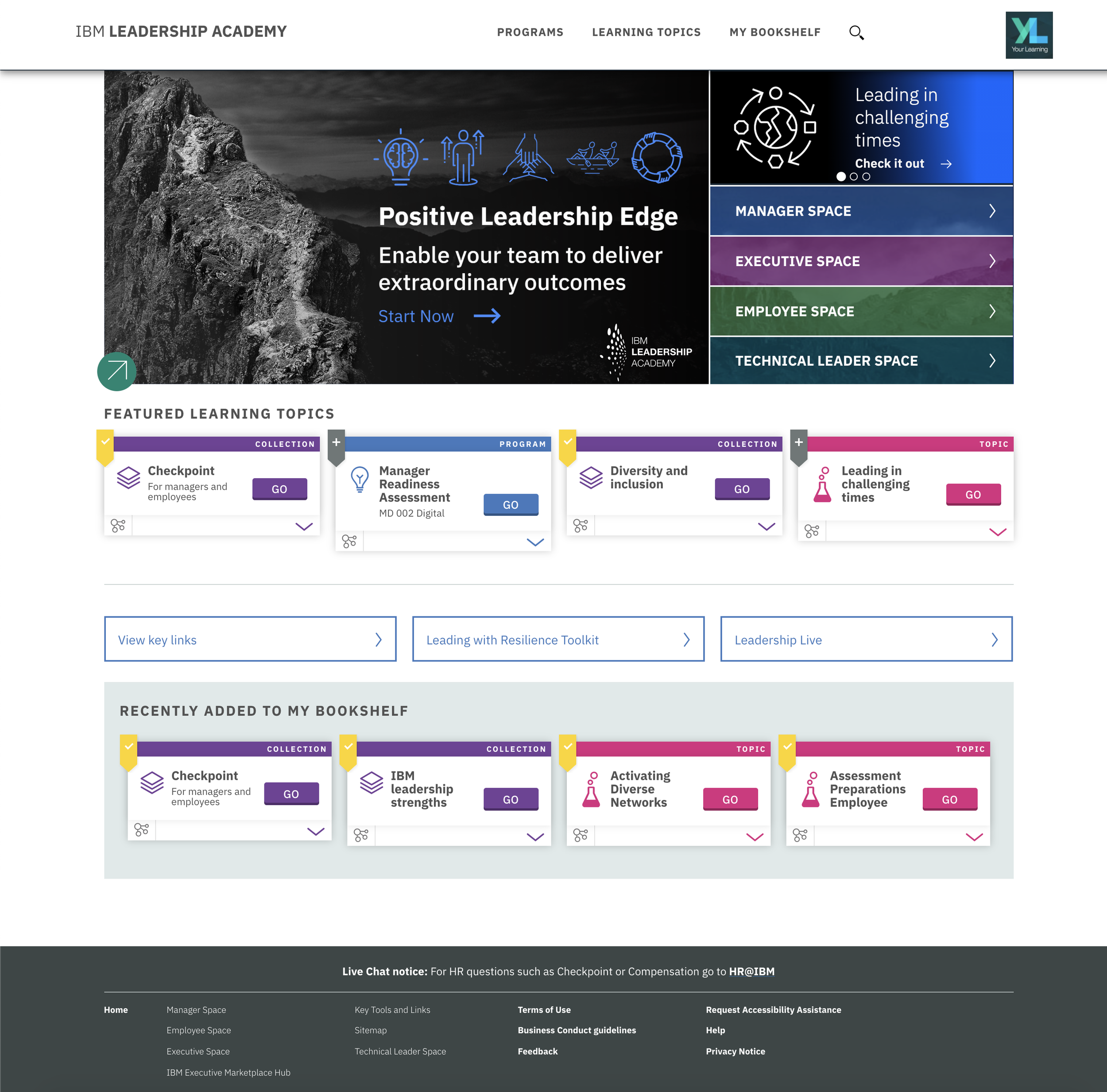
Original Leadership Academy homepage
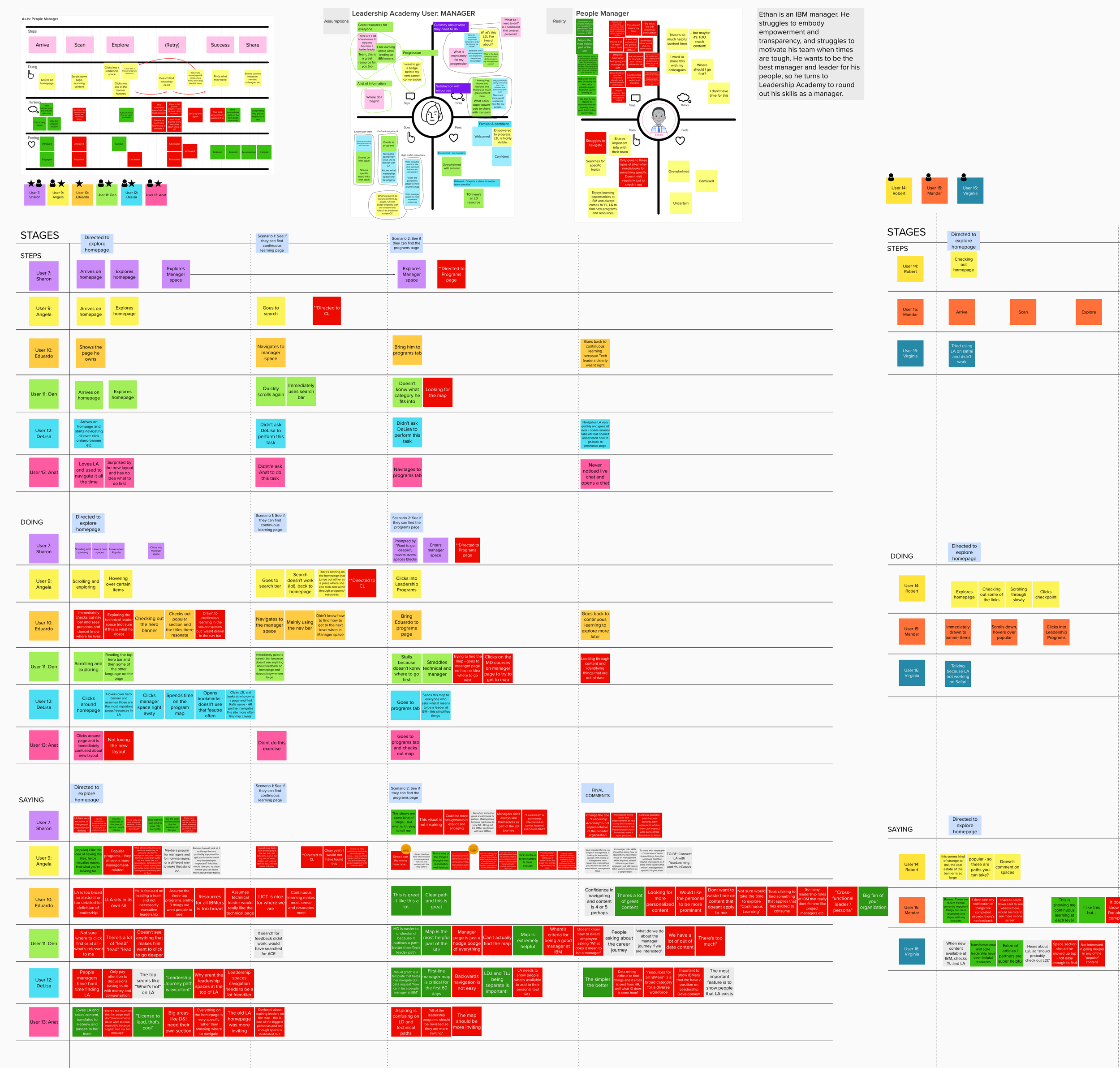
Snapshot of discovery research and as-is user journey captured in Mural
Prototyping & testing
After synthesizing the discovery research, I began redesigning each section of Leadership Academy within two-week Agile sprints. Working through the Enterprise Design Thinking "Loop," I continuously tested my redesigns by observing my users through remote user testing, reflecting upon the results, and making changes to fit their needs. I also used A/B testing to inform decisions such as information hierarchy, navigation style, and calls to action.
At the end of every sprint I presented the newly redesigned pages to our executive stakeholders alongside the data to validate my decisions. With stakeholder approval, I passed my designs along to my team's developers to build and launch each page in a staggered approach, starting with the homepage, continuing through each career persona page, and finally every program and resource page in order of prioritization based on visit analytics.
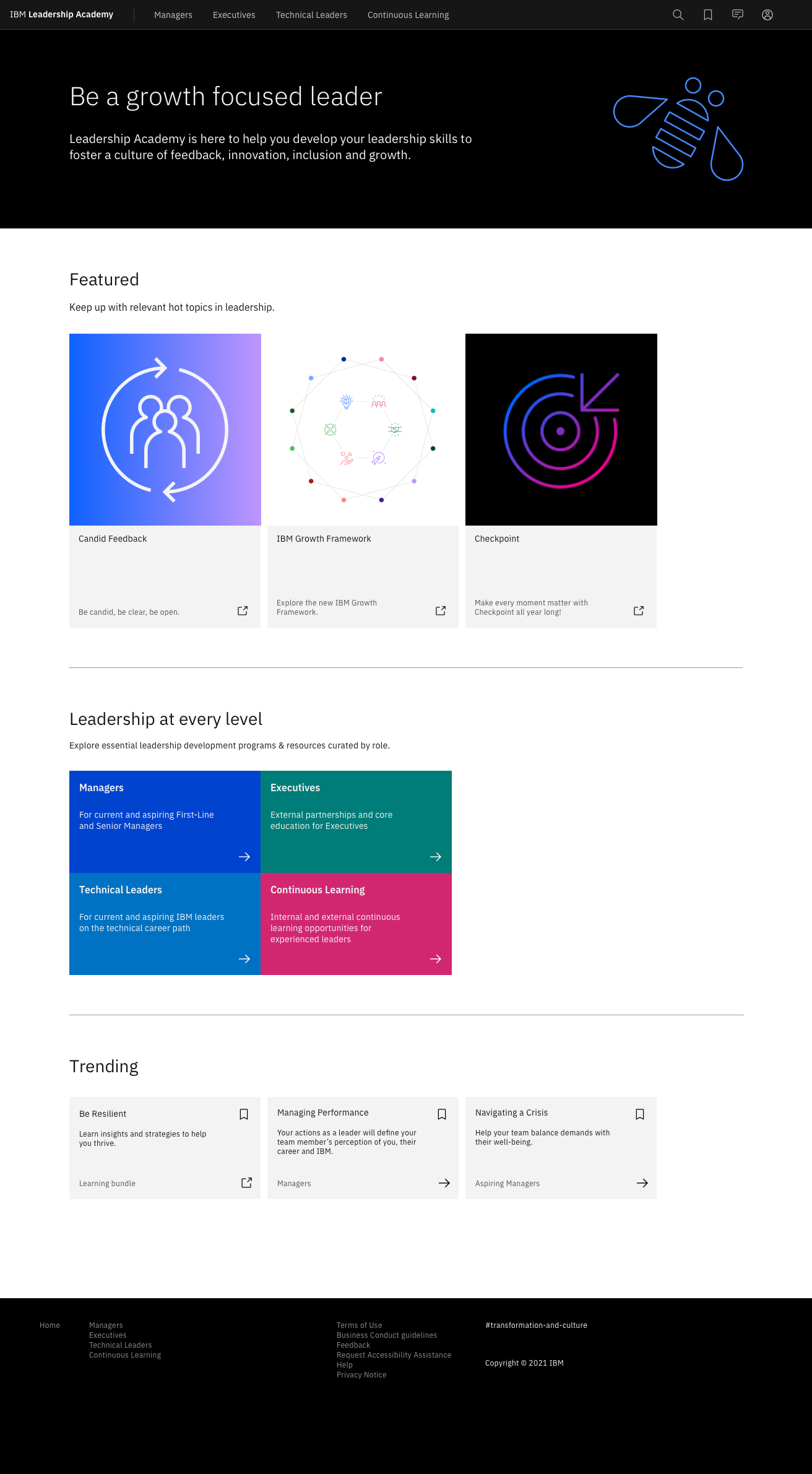
Redesigned Leadership Academy homepage
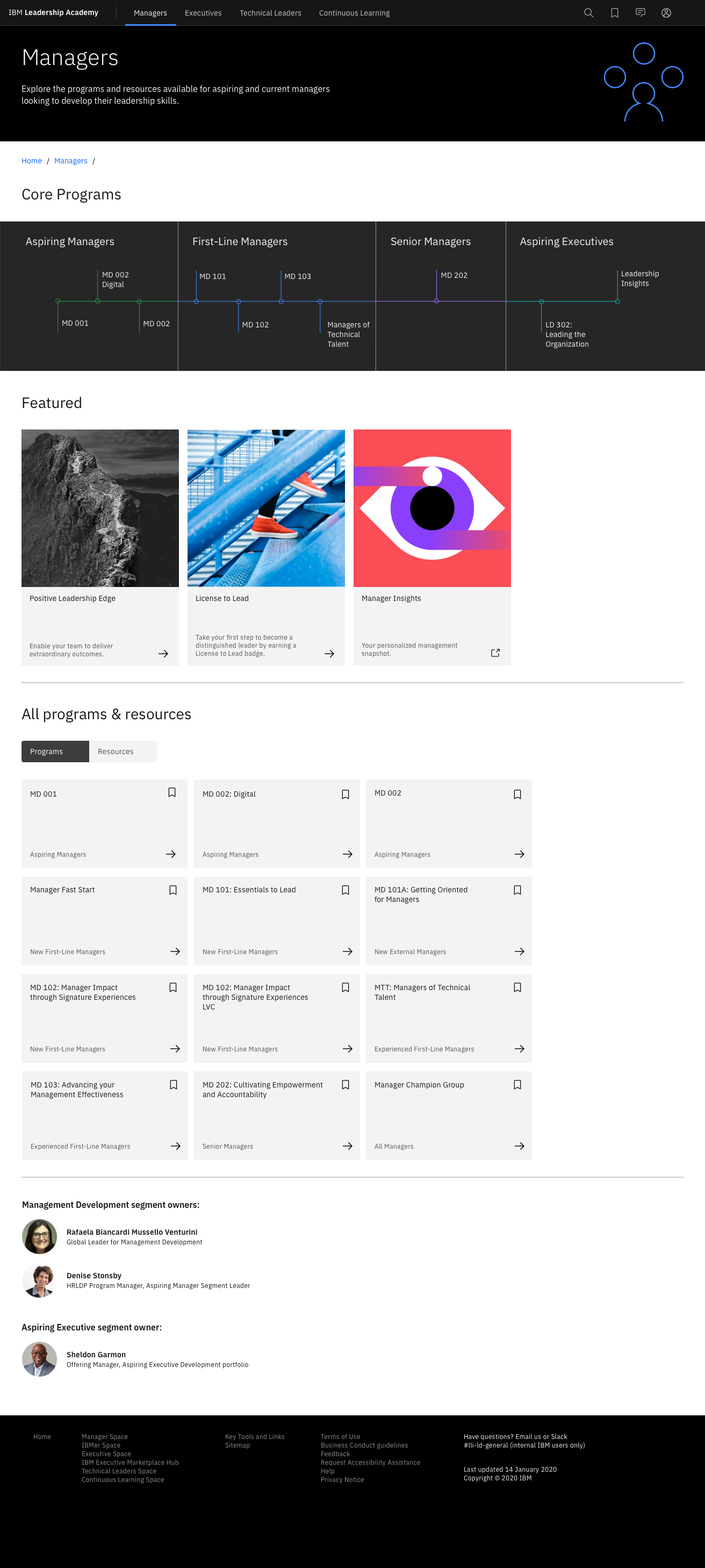
Curated content page for Managers featuring programs and resources created by our team
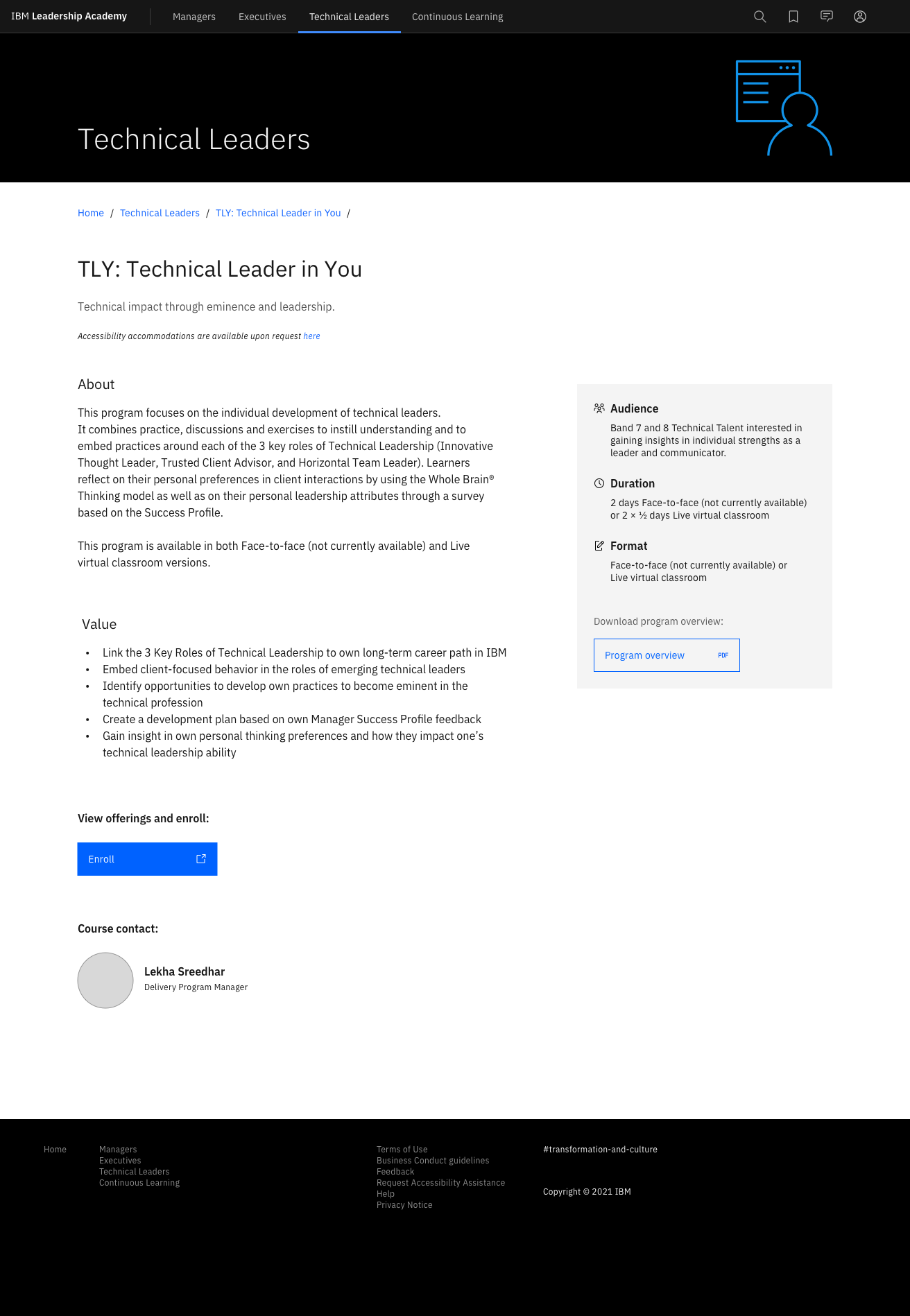
Example program page for the "Technical Leader in You" learning program, where users can learn more and enroll
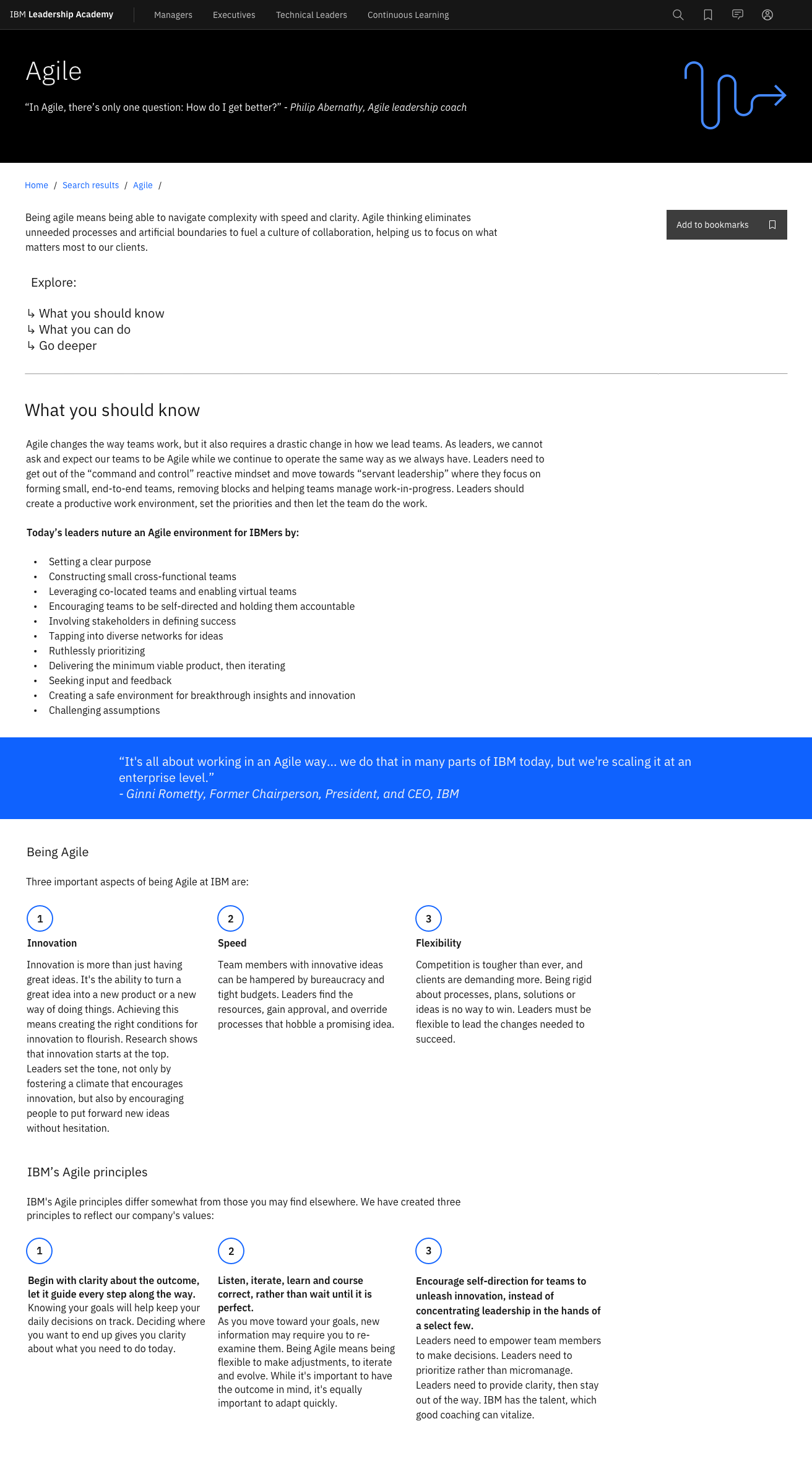
Example "Topic" page, showcasing content written by our team about Agile
OutcomesThe redesigned IBM Leadership Academy successfully led to an increase in program enrollment and engagement with our content—despite workplace challenges introduced by the COVID-19 pandemic.
We had to adapt our programs and resources quickly to the “new normal” of virtual, remote work. The IBM Leadership Academy played a critical role in keeping employees engaged in their careers and their personal development. The new website design also received an NPS score considered “excellent” by IBM’s internal metrics, seeing an increase of 25 points since launching.
This project also surfaced an important lesson in quality over quantity. We started out trying to gather as much feedback from as many users as possible—after all, the target audience of the Leadership Academy is technically all 300,000+ IBM employees! However, I realized that a group of dedicated sponsor users, carefully chosen to represent each persona in our target audience, could offer more valuable feedback since they were invested in our work and remained updated on every step of our process.